 Pin This
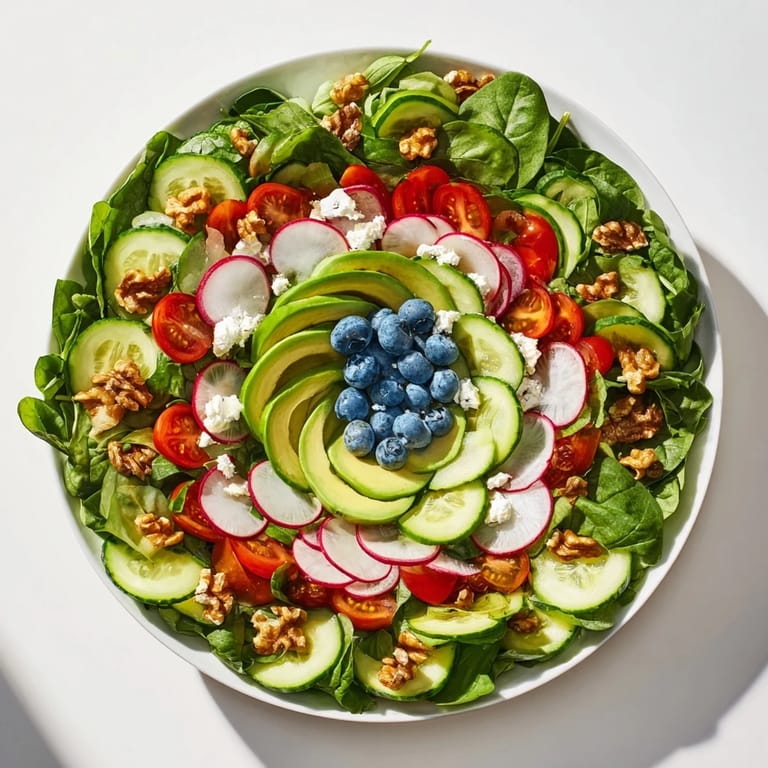
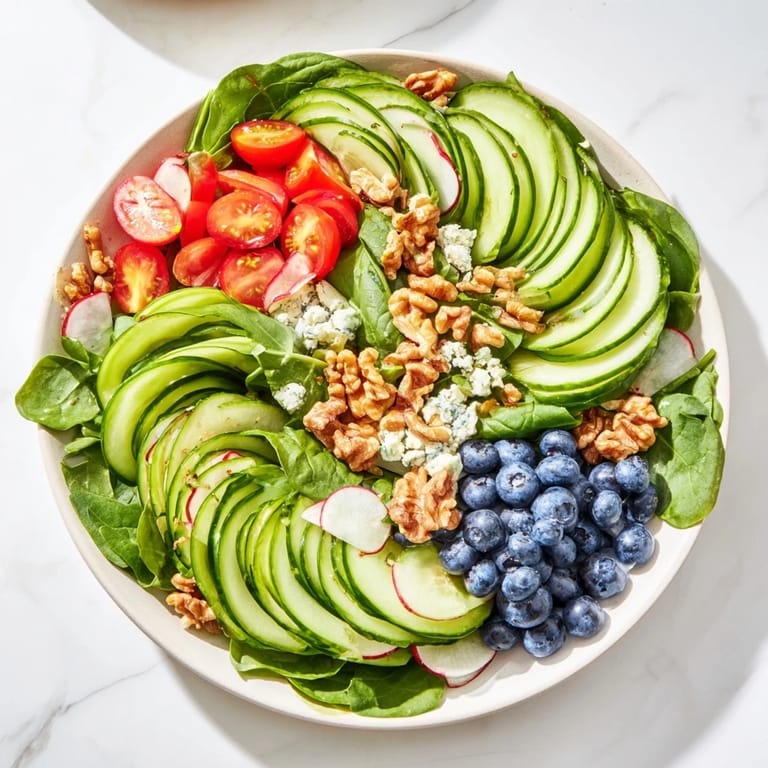
 I discovered the magic of arranging food in spirals quite by accident while reorganizing my spice rack one afternoon, and it stuck with me. Years later, when I found myself staring at a pile of beautiful produce—vibrant greens, jewel-toned berries, creamy avocado—I realized I could create something that felt less like a salad and more like edible art. The Fibonacci Fan Salad was born from that impulse: the desire to make something that tastes as good as it looks, where every bite carries a perfect balance of flavors because of how thoughtfully each ingredient finds its place.
The first time I made this for guests, I arranged everything on a giant platter and watched their faces as I brought it to the table—there was this moment of stunned silence before someone said, "Did you really make this?" It became the kind of dish people photograph before eating, and honestly, that felt like its own kind of victory. Knowing that something I created could spark that reaction made every careful slice and thoughtful placement absolutely worth it.
Ingredients
- Baby spinach leaves: The tender innermost arc that starts your spiral, mild enough to let other flavors breathe.
- Arugula: Its peppery bite cuts through the richness of cheese and avocado, and the shape works perfectly for fanning outward.
- Cherry tomatoes, halved: They bring acidity and brightness, and halving them lets you nestle them snugly into your spiral pattern.
- Cucumber, thinly sliced: The cool crispness is essential; slice it thin enough that it drapes slightly.
- Radishes, thinly sliced: Their crunch and subtle spice add complexity, and the thin slices bend beautifully around your arc.
- Red onion, finely sliced: Use it sparingly as an accent ring—it's potent and will dominate if you're not careful.
- Avocado, sliced: Choose one that's ripe but still holds its shape, and use a melon baller or spoon to nestle the slices in.
- Blueberries: They're not just pretty dots; they add subtle sweetness and acidity that rounds out the palate.
- Toasted walnuts, chopped: Toast them yourself if you can—the difference between fresh-toasted and store-bought is honestly night and day.
- Crumbled feta cheese: It's the bridge between all these disparate flavors, creamy and salty at once.
- Extra-virgin olive oil: Don't skimp here; this is your dressing's backbone.
- Lemon juice: Fresh-squeezed makes a real difference in brightness.
- Honey: Just a touch to balance the acidity and round the flavors.
- Dijon mustard: The emulsifier that makes your dressing silky and adds depth.
- Salt and black pepper: Taste as you go; you'll be surprised how much seasoning a composed salad can handle.
Tired of Takeout? 🥡
Get 10 meals you can make faster than delivery arrives. Seriously.
One email. No spam. Unsubscribe anytime.
Instructions
- Start with your base spiral:
- Arrange the baby spinach in a gentle crescent on your platter, imagining it as the heart of a shell curling outward. This sets your rhythm and scale for everything that follows.
- Fan out your arugula:
- Layer the arugula leaves slightly overlapping in the next ring, bigger than the spinach crescent. You're not being precise here; let them curve naturally and follow the motion of your hand.
- Build the expanding rings:
- Continue with cherry tomato halves, then cucumber slices, then radishes, each section slightly larger and further out than the last. Think of it like adding ripples to water rather than drawing perfect circles.
- Add your accent ring:
- Place the red onion slices as a thin line near the outer edge, almost like you're underlining the design. Resist the urge to cover everything; restraint is what makes this special.
- Tuck in the luxuries:
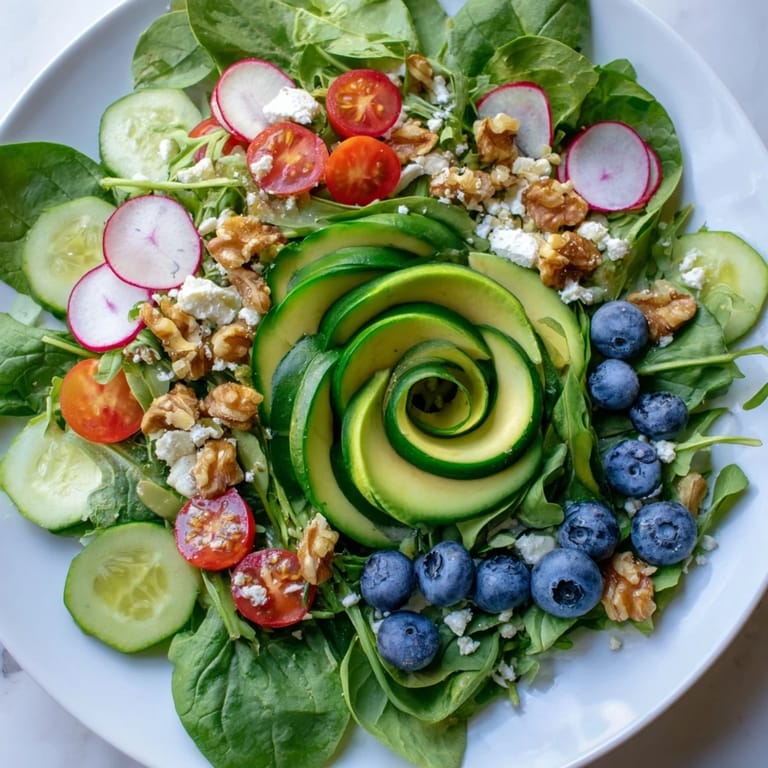
- Slip the avocado slices and blueberries into gaps throughout the spiral, spacing them so they're evenly distributed but never feel crowded. Step back and look at it; you're arranging, not filling.
- Crown your salad:
- Scatter the toasted walnuts and feta across the whole thing, letting them settle into the crevices. A few pieces can sit more prominently on the outer edges for extra visual interest.
- Whisk your dressing:
- In a small bowl, combine the olive oil, lemon juice, honey, and Dijon mustard, whisking until it emulsifies and turns slightly pale. Taste it on a leaf of spinach; adjust salt, pepper, and lemon to your preference.
- The final pour:
- Just before serving, drizzle the dressing over the arranged salad in a thin, even stream. Do this at the table if you can; there's something about that moment that makes the whole dish feel more celebratory.
 Pin This
 I remember bringing this salad to a potluck at a friend's house and watching it become the thing everyone came back to, not just for the taste but because eating it felt like participating in something beautiful. That's when I understood that food isn't just fuel—sometimes it's a small moment of joy shared, a tangible reminder that we can create something memorable from humble vegetables and intention.
The Geometry of Good Eating
The Fibonacci spiral isn't just a pretty mathematical concept—it's a way of thinking about balance that actually translates to better eating. When you arrange ingredients in expanding sections, you're naturally preventing any single flavor from dominating, and you're ensuring that texture and color vary with every forkful. I've noticed that salads arranged this way make people slow down and notice what they're eating, rather than just rushing through.
Making It Your Own
The beauty of this salad is how adaptable it is to what you have on hand and what you're craving. If avocado isn't in season or feels expensive, pear slices work beautifully and add a different kind of sweetness. If you want protein, grilled chicken sliced thin nestles into the spiral perfectly, or you can scatter roasted chickpeas for a vegetarian boost. The structure stays the same; only the players change.
Dressing and Storage Wisdom
The dressing is intentionally simple because these ingredients speak for themselves, and you want them to shine rather than hide under something heavy or aggressive. I've learned the hard way that overdressing a composed salad ruins all your careful arrangement work, so less is more. If you end up with leftover dressing, keep it refrigerated in a jar and shake it before your next use—it's perfect for drizzling over roasted vegetables or grain bowls throughout the week.
- Make the dressing up to two hours ahead; it actually gets better as it sits and the flavors meld.
- If you're transporting this somewhere, keep everything separate and assemble only at your destination.
- Leftover components (not dressed) will keep refrigerated for a day, making this easier to execute on a weeknight than you'd think.
 Pin This
 This salad taught me that sometimes the most memorable dishes aren't about complexity or technique—they're about attention, arrangement, and caring enough to make something that's as lovely to look at as it is to eat. Serve it with confidence.
Recipe Q&A
- → What is the best way to arrange the salad ingredients?
Arrange the ingredients in expanding arcs following a golden spiral, starting with baby spinach as the innermost layer and layering other components outward for visual balance.
- → Can I substitute the cheese in this salad?
Yes, goat cheese can be used as an alternative to feta for a different tangy flavor and creamy texture.
- → How can I add protein to this salad?
For added protein, top the salad with grilled chicken or cooked chickpeas while maintaining its fresh character.
- → What dressing complements the salad best?
A simple dressing of extra-virgin olive oil, lemon juice, honey, Dijon mustard, salt, and pepper enhances the fresh and tangy flavors perfectly.
- → How should the salad be served to keep it fresh?
Serve immediately after dressing to maintain the crispness of the fresh produce and the overall presentation.