 Pin This
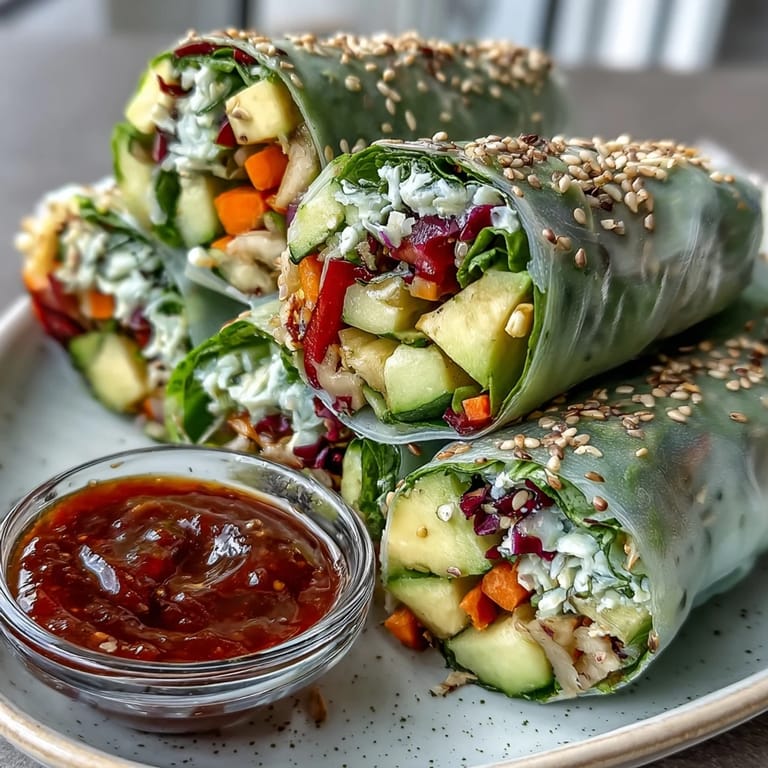
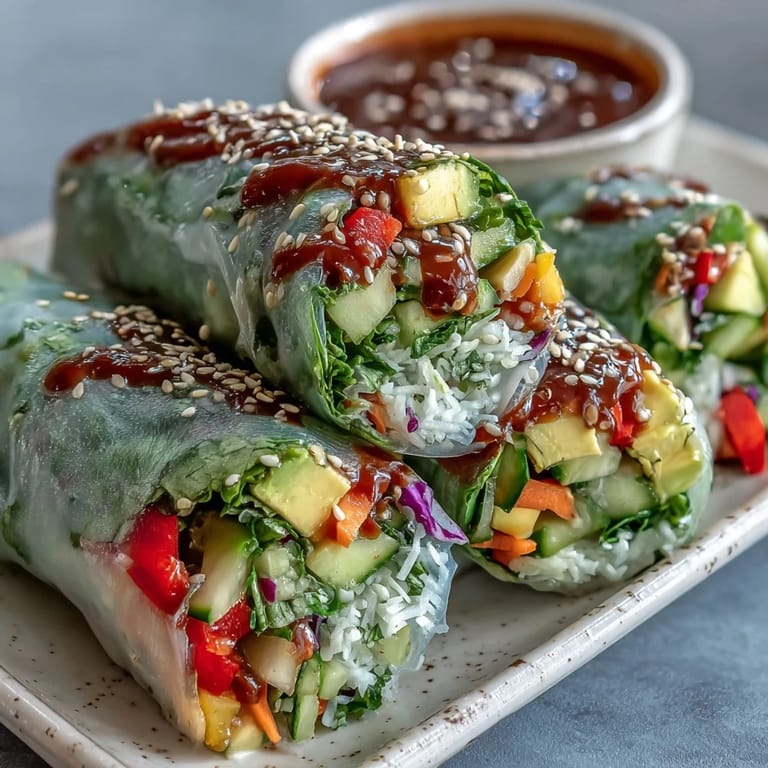
 There's something almost meditative about assembling spring rolls on a warm afternoon, your hands moving through the ritual of dipping, arranging, and rolling without much thought. I discovered these vegan mango and avocado rolls quite by accident, actually, when my friend brought a similar version to a picnic and I couldn't stop eating them. What struck me most was how each bite felt like biting into summer itself—the mango's sweetness, the avocado's butter-soft creaminess, all held together by those delicate rice paper wrappers. Now they're my go-to when I want something that looks impressive but doesn't require you to turn on the stove.
I made these for my sister's birthday dinner last summer, and what I didn't expect was how my nephew would abandon his regular food to try one—and then ask for four more. Watching someone discover that vegetables and fruit can be this delicious was honestly the best part of the evening. It turned into this funny moment where he was carefully deconstructing each roll to understand exactly what was inside, like solving a delicious puzzle.
Ingredients
- Rice paper wrappers (8, 22 cm diameter): These are your vessel, and they need to be the right thickness—thin enough to be delicate but sturdy enough not to tear when you roll them, so don't grab the cheapest package you find.
- Ripe mango: The sweetness of a truly ripe mango is what makes these rolls sing, so pick one that yields gently to pressure and smells fragrant at the stem end.
- Ripe avocado: This is your creamy element, and timing matters because avocado goes from perfect to brown in what feels like five minutes, so slice it just before assembling.
- Carrot, julienned: The slight sweetness and satisfying crunch anchor all the softer elements in each bite.
- Cucumber, julienned: Its cooling, refreshing quality keeps things light and prevents the rolls from feeling heavy.
- Red bell pepper, thinly sliced: Beyond the bright color, it adds a subtle sweetness and a gentle crunch that contrasts beautifully with the softer ingredients.
- Purple cabbage, shredded: It's sturdy enough not to get soggy and adds an earthy undertone that balances the fruit.
- Fresh mint, cilantro, and basil leaves: Don't skip the herbs or use dried ones—fresh herbs are what transform these from okay to unforgettable, and each one adds its own personality.
- Sweet chili sauce: Whether store-bought or homemade, this is your flavor anchor, so taste it before mixing to adjust proportions to your heat preference.
- Lime juice: A squeeze of acid brightens everything and cuts through the richness of the avocado.
- Soy sauce or tamari: Use tamari if you're serving this to someone avoiding gluten—it makes the sauce more complex without any compromise.
- Toasted sesame seeds (optional): They add a subtle nuttiness that makes people ask what that mysterious flavor is.
Tired of Takeout? 🥡
Get 10 meals you can make faster than delivery arrives. Seriously.
One email. No spam. Unsubscribe anytime.
Instructions
- Set up your mise en place:
- Arrange all your sliced vegetables, mango, avocado, and herbs on a platter so everything's within arm's reach—this step makes the actual rolling smooth and prevents that panicked moment of searching for where you put the cilantro. Trust me, you'll be grateful for this setup once you start working with the wrappers.
- Prepare your water bath:
- Fill a large shallow dish with warm (not hot) water; you want it comfortable to touch. This warm water is what brings the rice paper to life, softening it just enough to become pliable without turning it into a sticky mess.
- Soften the first wrapper:
- Submerge one rice paper in the warm water for about ten to fifteen seconds—honestly, this is where most people either over-soak or under-soak, so start at ten seconds and you can always add a second or two. You're looking for it to have some give but still maintain a bit of resistance; it'll continue to soften slightly as you work with it.
- Lay and load:
- Place the softened wrapper on a clean, damp kitchen towel or cutting board and arrange your filling in the lower third of the wrapper—don't overload it because the wrapper is fragile and has to fold over everything without splitting. Think of it like you're creating a decorative line of vegetables that's about two inches wide; it looks elegant and actually rolls properly.
- The roll and fold technique:
- Fold the bottom edge over the filling, then tuck in the left and right sides (like wrapping a burrito), and roll tightly upward—the key is that first fold down is where the magic happens, so get it snug before you fold the sides. Roll with confidence but not so hard that you squeeze out all your filling; your hands will figure out the right pressure after the first one or two.
- Repeat with intention:
- Work through the remaining wrappers one at a time, and don't worry if your first few aren't perfect spirals—they still taste amazing and honestly look more handmade and charming than perfectly uniform rolls. By roll number four or five, your hands will know exactly what to do.
- Mix your dipping sauce:
- In a small bowl, whisk together the sweet chili sauce, lime juice, and soy sauce or tamari, then taste it and adjust—if it's too spicy, add a touch more chili sauce; if it needs more brightness, squeeze in more lime. Sprinkle with toasted sesame seeds if you're using them, which adds a subtle depth that keeps people guessing.
- Serve and enjoy:
- Spring rolls are honestly at their absolute best served immediately, while everything is still at its peak—the vegetables haven't started weeping, the herbs taste fresh, and the wrapper still has that silky texture. Serve them with the dipping sauce on the side and watch people light up.
 Pin This
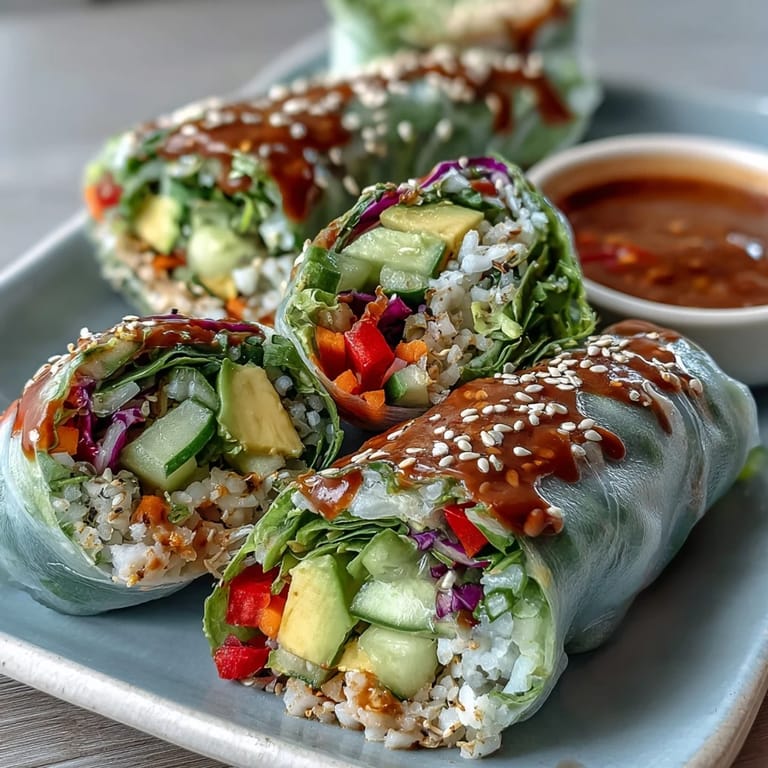
 There was this one evening when my partner came home exhausted from work and I had these spring rolls waiting in the refrigerator, already rolled and ready to go. Watching him take that first bite and visibly relax was a reminder that sometimes the most nourishing meals are the ones that require zero effort to heat up but taste like someone really cared. Food like this bridges that gap between self-care and hospitality.
Building Flavor Through Texture
What makes these rolls so satisfying isn't just any single ingredient—it's the conversation between the different textures happening in every bite. The soft mango and avocado need the crisp snap of the cucumber and carrot to make sense; without that contrast, everything becomes a monotonous blur. The fresh herbs cut through all of that with brightness, like a bell ringing to remind you that you're eating something alive and vibrant. I learned this the hard way when I once tried to make rolls with only soft ingredients and they felt somehow boring despite being technically perfectly constructed.
The Art of the Perfect Water Dip
Rice paper wrappers have this mysterious quality where they go from stiff and impossible to ethereally delicate in seconds, and honestly, that moment when you pull one out and it's suddenly pliable feels like small kitchen magic every single time. The temperature of your water matters more than you'd think—too cold and it takes forever, too hot and you end up with a torn wrapper you're fishing out of your bowl. Once you understand that sweet spot, you'll start timing it by feel rather than seconds, which is when you know you've really got the hang of this.
Storage and Make-Ahead Wisdom
The practical truth is that spring rolls are best within the first hour of rolling, when they're at their most tender and fresh-tasting. That said, I've wrapped them in damp paper towels and sealed them in plastic wrap in the refrigerator, and they hold up surprisingly well for up to twenty-four hours if you need them for meal prep or an event. Just know that the longer they sit, the more the flavors kind of meld together and the wrapper becomes a bit chewier, which isn't bad but definitely different from that fresh, vibrant taste.
- If you're making these for a party, prep all your vegetables hours ahead and keep them in separate containers, then do the actual rolling an hour or so before serving.
- Damp paper towels are your friend for storage because they keep the wrappers from drying out without making everything soggy.
- The sauce can absolutely be made a day ahead and tastes even better as the flavors have time to mingle.
 Pin This
 These spring rolls have quietly become my answer to the question of what to bring when someone asks me to contribute something to a potluck, because they're reliable, healthy, and they never fail to get compliments. They're proof that sometimes the most elegant food requires the least equipment and the most patience.
Recipe Q&A
- → What wrappers are best for these rolls?
Rice paper wrappers about 22 cm in diameter work best, providing pliability without tearing during assembly.
- → How do I keep the rolls from sticking together?
Place each roll on a lightly dampened surface or parchment paper, ensuring they don’t touch until serving.
- → Can I prepare these ahead of time?
They’re best enjoyed fresh but can be wrapped in damp paper towels and plastic wrap, then refrigerated for up to 24 hours.
- → What variations can I try with the herbs?
Thai basil, parsley, cilantro, or mint can be substituted or combined to add fresh herbal notes.
- → Is the sweet chili sauce homemade or store-bought?
Either works well; a homemade sauce with vinegar, sugar, soy sauce, and chili flakes adds a personalized touch.
- → Can I add protein to these rolls?
Yes, thin strips of marinated tofu or tempeh make excellent protein additions without overpowering the fresh flavors.