 Pin This
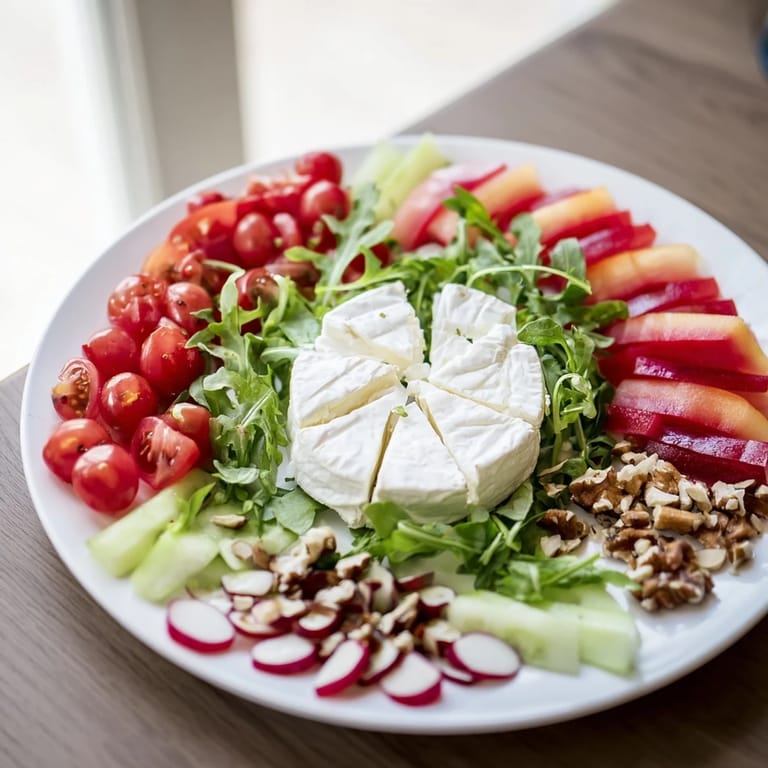
 I first constructed this salad when a friend challenged me to create something that would make guests stop mid-conversation. We were hosting a casual dinner, and I wanted the food itself to spark that moment of quiet appreciation before anyone took a bite. The idea struck me while arranging ingredients on a board: what if everything on the plate pointed toward something magnificent, like a visual compass needle? That's when the cheese wheel became the star, and everything else simply radiated outward like a deliberate architectural choice.
I'll never forget the silence when we set this down at dinner. My partner reached for the camera before the fork, and everyone leaned in like they were seeing a work of art. The cheese was perfectly ripe that day, just soft enough to cut with a butter knife, and somehow every person at the table ended up eating a version unique to them—pulling arugula here, adding a pomegranate seed there, each bite their own small decision.
Ingredients
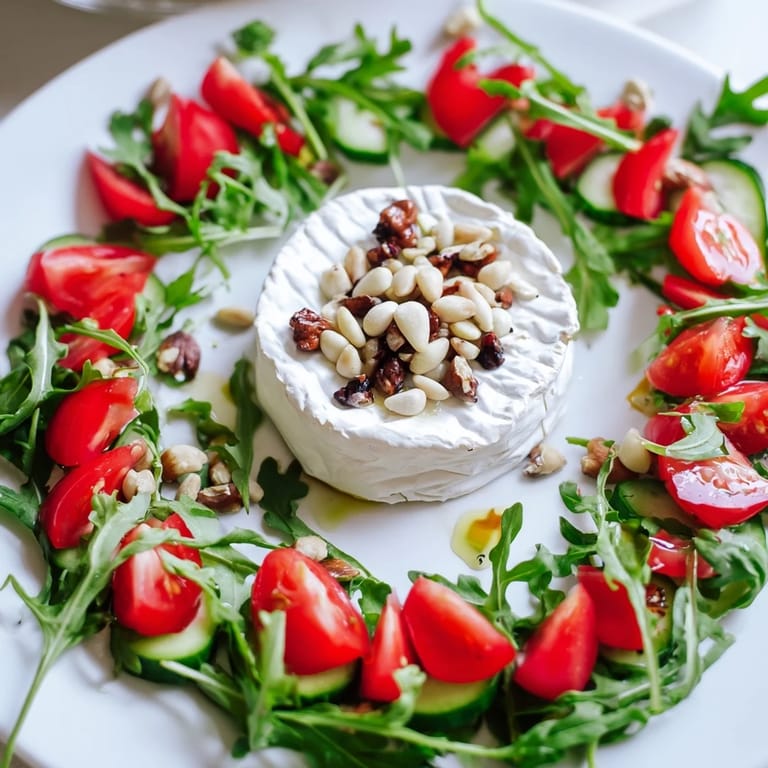
- Baby arugula: The peppery foundation that sweeps toward the cheese in graceful arcs, bringing a slight bite that balances the richness of what's coming.
- Cherry tomatoes, halved: Their halved faces catch the light and add color in neat rows, creating visual order while providing sweetness and acidity.
- Cucumber, thinly sliced: Cooling and crisp, these slices slide between other elements without competing, their delicate translucence adding to the overall design.
- Watermelon radish, thinly sliced: This is your secret weapon for unexpected color and a subtle spicy crunch that most guests won't see coming.
- Pomegranate seeds: They're tiny flavor fireworks and jewel-like punctuation marks scattered throughout, offering bright tartness in every few bites.
- Toasted walnuts: Toast them yourself until they smell irresistible—the crunch becomes textural contrast and the nuttiness grounds everything.
- Extra-virgin olive oil: Don't skimp here; this is half your dressing's personality, so use something you'd drink straight from the bottle.
- White balsamic vinegar: It won't darken your beautiful arrangement like regular balsamic would, keeping the visual drama intact while adding subtle sweetness.
- Honey: One teaspoon is all it takes to marry the sharp and the rich with something golden and warm.
- Dijon mustard: It emulsifies the dressing and adds a sophisticated sharpness that keeps things from feeling too fancy.
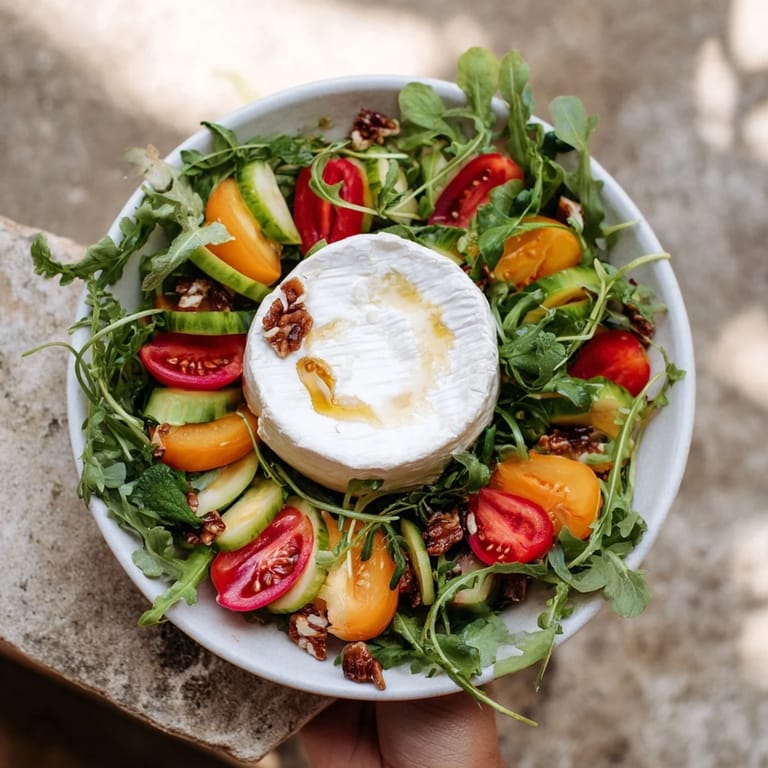
- Artisanal cheese wheel: This is the point of everything else on the plate, so choose something you genuinely want to eat—whether that's creamy Brie, funky Humboldt Fog, or delicate Saint-Marcellin.
Tired of Takeout? 🥡
Get 10 meals you can make faster than delivery arrives. Seriously.
One email. No spam. Unsubscribe anytime.
Instructions
- Position your centerpiece:
- Place the cheese wheel on a small plate or shallow dish positioned in a corner or off to one side of your large serving board. This anchors everything visually and gives you a focal point to build around.
- Create your first arc:
- Sweep the arugula outward from the cheese in a graceful, curved line, like you're drawing a compass arc. Let it flow naturally rather than measuring it precisely—imperfect lines feel more intentional.
- Build your geometric rows:
- Layer the cherry tomatoes, cucumber, and watermelon radish in separate, orderly rows, all angled toward the cheese. Think of yourself as drawing invisible lines from each ingredient back to center, creating a radial pattern.
- Add textural scatter:
- Distribute the pomegranate seeds and walnuts along your arranged ingredients, tucking them into gaps and maintaining that sense of direction toward the cheese wheel.
- Whisk your dressing:
- Combine the oil, vinegar, honey, and mustard in a small bowl, whisking until the mixture becomes silky and slightly thick. Taste and season carefully—you want brightness, not overwhelm.
- Dress with restraint:
- Drizzle the dressing lightly across the vegetables, deliberately avoiding the cheese wheel so it stays pristine and inviting as a destination rather than a component.
- Bring it to the table:
- Serve immediately while everything is crisp and the cheese is at its most elegant. Invite guests to cut into the cheese and combine it with whatever they're drawn to first.
 Pin This
 There's something about creating a dish where every component has a purpose beyond taste. When I finished arranging the salad that first time, I realized I was thinking about it the way someone arranges flowers or sets a table—with intention, with beauty, with the hope that it matters. And when people finally ate it, they weren't just consuming ingredients. They were participating in something.
The Art of Arrangement
This salad lives in the space between cooking and design. The geometry matters because it signals that care was taken, that you thought about how this would land. I learned through trial and error that asymmetry works better than perfect symmetry—a slightly wobbly arc of arugula feels more alive than ruler-straight lines. Let your hand move naturally, and the board will arrange itself beautifully.
Cheese Selection and Timing
The cheese makes this salad what it is, so it deserves its own consideration. I've built this with soft-ripened wheels because they offer creaminess that contrasts perfectly with the fresh vegetables, but I've seen people make stunning versions with crumbly blue cheese or herbed goat cheese wheels. Buy your cheese from someone who knows it—visit the counter, ask what's ripe today, and trust their recommendation. Serve it at room temperature so it's actually pleasant to eat, not cold and tight.
Variations and Improvisation
I've learned that this salad becomes yours through substitution. Some seasons I trade the cherry tomatoes for heirloom slices, other times I add thin prosciutto ribbons woven through the arugula. Edible flowers scattered across the surface add an unexpected elegance—I once used cornflowers and nasturtiums, and suddenly it felt like a summer garden on a plate. The architecture holds even when you switch ingredients, so feel free to play.
- Try Camembert or Humboldt Fog if you want to experiment with different cheese personalities and watch how each transforms the experience.
- Add smoked salmon or prosciutto for richness without abandoning the vegetarian option entirely—let guests choose what they want alongside.
- Edible flowers turn this into something almost too beautiful to eat, which is exactly the point of this dish.
 Pin This
 This salad is proof that sometimes the most memorable meals come from asking a simple question: what if we arranged it differently? Serve it when you want to feed people something nourishing, but also when you want them to feel considered and seen.